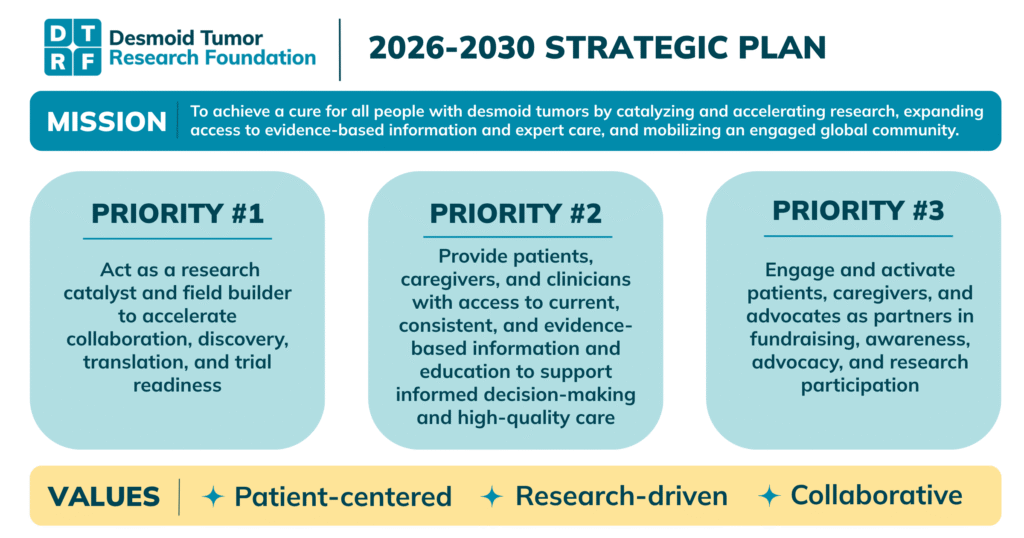
Over the past year, we’ve taken a deliberate and deeply collaborative look at where DTRF stands, and where we must go next to better serve the desmoid tumor community. Today, we’re proud to share our five-year strategic plan for 2026-2030.
DTRF Executive Director – Katie Doyle Myers explains the collaborative nature of DTRF’s strategic planning process:
Stepping into the Executive Director role during this process allowed me to learn from voices across our community. This plan is stronger because of that collaboration, and a clear reminder that progress in desmoid tumors will only happen when we work together with a shared purpose.
This strategic plan was shaped by the voices of our community. Through more than three dozen conversations with board members, scientific and medical advisors, researchers, clinicians, patients, caregivers, and donors, we listened closely to the experiences and insights that define this disease. We also examined the broader rare disease and sarcoma landscape to understand where the DTRF can have the greatest impact.
What we heard was clear: progress is happening, but there is more to do, and DTRF has a critical role to play in accelerating it.
In recent years, the desmoid tumor field has reached important milestones, including the FDA approval of nirogacestat and a growing pipeline of promising therapies in clinical trials. The DTRF has been proud to help lay the groundwork for this progress, investing more than $4.2 million in research to better understand the biology of desmoid tumors, work that not only advances our disease, but may also unlock insights relevant to other rare diseases and even common cancers.
The role of our community has been just as important. Patients and caregivers have shared their experiences to inform research, guide education, and advocate for change. They have also fueled this work through grassroots fundraising and philanthropy. Our Board of Directors, who bring lived experience with desmoid tumors alongside deep professional expertise, have helped translate that collective perspective into a focused and actionable plan. Our scientific and medical advisors continue to push the field forward, driving toward more and better treatment options, collaborative efforts, and ultimately, a cure.
Throughout this process, we refined both our vision and our mission. Our vision is a shared one: to cure desmoid tumors. It is ambitious by design, and it belongs to all of us. Our mission clarifies how the DTRF will help get us there. We are committed to accelerating research, providing evidence-based education and information for patients and clinicians, and convening our community to foster collaboration, connection, and progress. What’s new in this plan is the intentional integration of these efforts, ensuring that each informs and strengthens the others.

We have also set a bold goal: by 2030, DTRF will invest more than $1 million annually into desmoid tumor research. Reaching this level of investment will allow us to fund critical early-stage ideas, support promising clinical research, and continue attracting scientific talent to this field.
DTRF’s Board Chair – Yating Wong shares about the impact of the planning process and gratitude for everyone involved:
This strategic plan establishes a clear trajectory for the future of the DTRF. It sharpens our organizational focus, catalyzes action across our multi-stakeholder community, and ensures that everyone impacted by desmoid tumors feels more informed, supported with evidence‑based care, and—most importantly—never alone in this fight. I’m energized by what’s possible when we align our priorities, deepen collaboration, and invest boldly in the pursuit of a cure. My sincere thanks to Katie and to everyone who contributed to developing this clearcut plan, and to all who will help bring it to life.
We are deeply grateful to everyone who contributed their time, perspective, and passion to this work. This plan is stronger because of you, and it is only possible because of you. The next five years represent an important moment for the DTRF.